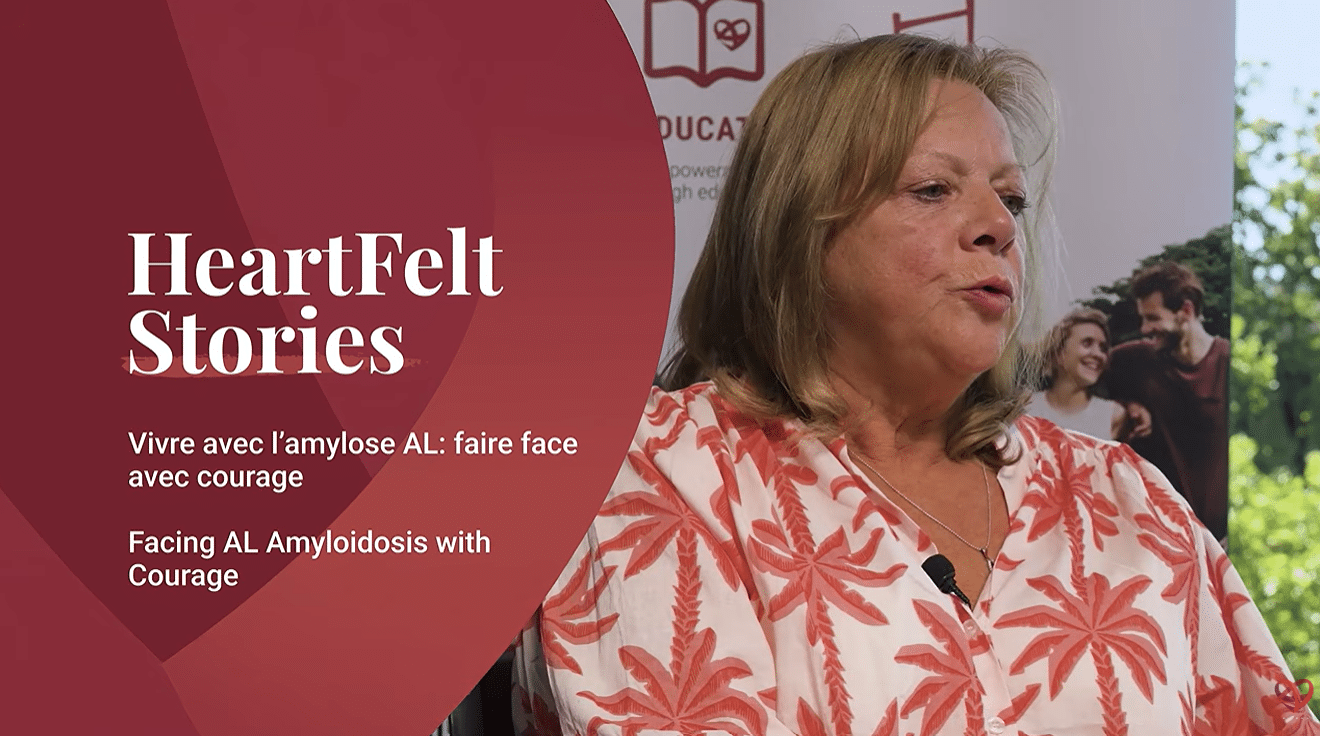
My Story
In October 2018, we went on a family cruise, and when I came back, my legs were very swollen and I was experiencing unusual shortness of breath. I was feeling increasingly unwell and finding it harder and harder to breathe. On the advice of my GP, I went to see another cardiologist. Everything then happened very quickly. I learned that not only was my heart severely affected, but both my kidneys were too. Two days later, the haematologist confirmed my diagnosis of AL amyloidosis.
At that point, what I felt most was confusion. I was being told that it wasn’t serious, but my condition was getting worse and worse. I didn’t understand what was happening to me. I had so many questions that remained unanswered. When I was told that my life expectancy without treatment was a maximum of six months, I didn’t really realise that it was happening to me. It was as if I were in a film, in a nightmare.
The support of my family
Chemotherapy was really difficult. From the third or fourth month of treatment, my body was deteriorating more and more. I was getting weaker and weaker. At one point, I couldn’t even get out of bed. Getting dressed on my own and managing my daily personal care had become extremely difficult. I felt life slowly slipping away from me, leaving my body.
But the support of my husband, my children and my family was a real comfort. My husband was always there for me, during the most difficult moments. He always supported me and gave me courage. At that time, my daughter was expecting her second child, and I absolutely wanted to be part of my grandchild’s life. I wanted to see the baby, be there for them, watch them grow up and get to know them. It was very important to me, and it gave me enormous courage to keep fighting.
Learning to live with the disease
After my first treatment, my body gradually recovered, which allowed me to return to a fairly normal life, so to speak. However, in October 2024, I relapsed. I was then given immunotherapy, but my body reacted very badly. I was hospitalised for eight days and became very ill again.
Today, every day is different. There are days when I feel relatively well, so to speak, and then there are other days when I feel extremely tired and exhausted. What I have really had to accept is living with fatigue and exhaustion, and no longer being able to do everyday things as I used to. I can still do the housework, but I have to do it in stages. At first, accepting this wasn’t always easy. But on the other hand, I can still do things. I can still live a life — of course, a more limited one, not like before, but I am still living.
"You are not alone in this fight."
Finding support from other patients
If I am sharing my story today, it is not so much to talk about myself, but above all to give hope to people who have just received their diagnosis. I know how they might feel. When you receive a diagnosis, you are afraid and have so many questions. What is happening to me? What is this? What lies ahead? By telling my story, I can say to these people: don’t lose faith. You are not alone in surviving this. You are not alone in fighting.
That is also the aim of Amibel: to help people who have just learned that they have the disease, support them and tell them they are not alone. As patients, we understand each other better and can explain our feelings more easily. When we talk about our feelings with our partners or family, they try to understand, but deep down, they don’t truly know what we are feeling. It is easier to talk to another patient who has the same disease as us. We understand each other better, we can offer advice, and we talk about our treatments, their side effects, what is happening to us and what lies ahead.
Enjoying the simple things in life
The disease has mainly taught me not to worry so much about little, everyday things and to make the most of my time with my family. We appreciate family dinners more, going out with our children and friends, and simply enjoying the little things in life.
I am particularly proud that I never lost faith, that I continued to believe and managed to overcome this disease. The disease is inside us, and unfortunately, it will always be there. But I am here today to tell you my story and, as you can see, I am no longer confined to my bed. This has been my greatest personal battle, and I am proud of that.
"If my story can show that it is possible to carry on living, laughing, loving and enjoying life, then I will have achieved my goal."
A message of hope
The most important thing is to receive a diagnosis as early as possible. My message to all doctors is to pay attention to the person in front of them. It could be amyloidosis. They need to look further into what is wrong, rather than simply saying that everything will be fine and that it isn’t serious.
Don’t lose faith; hold on to hope. There is always hope. Treatments are evolving, and medicine is advancing rapidly. New treatments are becoming available, and many people are living for a long time with this disease. Go to specialist centres and patient organisations, consult them and ask for information. Talk to other patients and hold on to hope. If my story can show that it is possible to carry on living, laughing, loving and enjoying life, then I will have achieved my goal.
Resources

Living with Atrial Fibrillation Discussion Guide – Spanish

A Patient’s Journey After a Stroke – Spanish
